
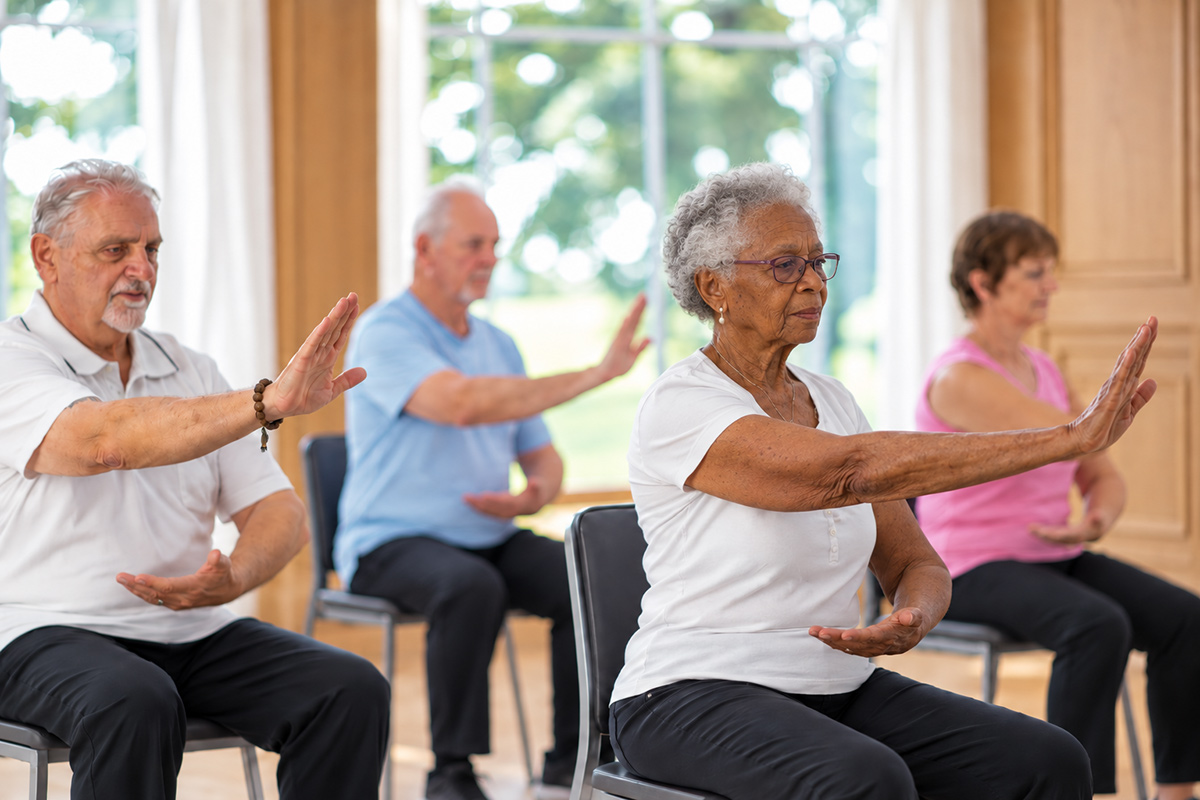
Physical well-being is dependent on a variety of physical skills. This is especially true at Ecumenical Retirement Community, where residents may have very different levels of mobility. Some use walkers. Others may tire easily or have difficulty with traditional exercise.
For the Rev. Howard West, Director of Spiritual Life at Ecumenical Retirement Community and sister company, Country Meadows Retirement Communities, Tai Chi is more than another activity on the calendar. It is a gentle way to help residents move, breathe, relax and reconnect with themselves.
Rev. West has studied Tai Chi for about 10 years and Chinese martial arts for roughly 40 years. In 2026, he decided to become certified so he could bring more of that experience into senior living.
The Tai Chi he offers at this retirement home community is seated, making it possible for more residents to participate comfortably. “My hope is to offer very gentle exercises that anybody can do.”
Breathing, balance and connection
For someone unfamiliar with Tai Chi, Rev. West describes it simply. “It’s a Chinese-based exercise that focuses on breathing, balance and connecting with your body, with gentle, soft movements,” he says. “There aren’t many forms or postures. The patterns are simple but deliberate. The real benefit is in how we execute them.”
That makes Tai Chi different from many familiar forms of exercise. Cardio is designed to raise the heart rate. Strength training focuses on building muscle. Tai Chi occupies a different space.
“It’s breathing, balance and connecting with your body,” he explains. “And residents often notice the difference after just one class.”
Rev. West often finishes a class by asking his retirement home community participants how they feel. The answers are remarkably consistent.
“People say things like, ‘I feel more relaxed. I feel more energized. I feel calmer inside, not as worrisome and just peaceful,'” he adds.
Movement that reaches beyond the physical
As Director of Spiritual Life, Rev. West also sees a natural connection between Tai Chi and spiritual well-being. Spirituality is not simply intellectual. It involves being fully present and aware of the connections between mind, body, other people and something larger than ourselves.
“My definition of spirituality is the experience of being connected,” he emphasizes. “It’s being, not just doing or thinking.”
Practices such as Tai Chi can help people move away from the stress of constant thinking and worrying by directing attention back toward breathing and the body.
“A lot of people in our world are stuck in their heads,” he says. “This type of exercise helps people get centered in their bodies and feel that connection internally and externally.”
For residents in a retirement home community who may be coping with physical limitations, pain, confusion or other challenges that come with aging, even a short period of calm and focused movement can be meaningful.
Rev. West sees a half-hour class as an opportunity for residents to settle themselves mentally and physically.
“I can still do something like this”
Perhaps the greatest value of Tai Chi becomes clear when retirement home community residents surprise themselves. Rev. West explains that one woman arrives for class in a walker and has difficulty transferring into a chair. Still, she participates.
Afterward, she tells him how different she feels. “She tells me she notices she gets both energized and relaxed. This resident can’t believe that something simple like Tai Chi can make her feel better, when she’s battling with so many physical challenges'” Rev. West adds.
Another participant, who is turning 93, told him during a qigong exercise, a related Chinese movement and breathing practice, she actually felt a sense of energy in her hands and arms. Those kinds of moments are important to Rev. West because they show residents that active living is within their reach. It does not have to mean pushing harder, moving faster or doing more.
An invitation to try
Rev. West knows the words “Tai Chi” may sound unfamiliar to some retirement home community residents. He has even considered giving the class another name. “I was thinking of renaming it something like ‘soft strength fitness,'” he says.
That description captures much of what the class offers: movement without strain, concentration without pressure and exercise that can be adapted to the individual.
His invitation to Ecumenical residents who are unsure is simple. “This is just an exercise anybody can do that’s based on a Chinese system of exercises called Tai Chi. I ask our residents to come experience it and see.”
At Ecumenical, that willingness to try something new is part of active living itself. Tai Chi provides retirement home community residents with another way to move, participate and reconnect with their bodies at whatever level is right for them.
And for Rev. West, the goal is not complicated. It is to help people feel a little more balanced, a little more peaceful and a little more connected than they did when they walked, or rolled, into the room.
Considering a retirement home community in Harrisburg, Pennsylvania?
Tai Chi is just one way we help our residents live their best lives. If you’re considering a retirement community for yourself or a loved one, please reach out to start the conversation. We look forward to welcoming you to campus and showing you all the ways Ecumenical Retirement Community may be a good fit for you.